From the Studio
Ear Piercing Chart: All 16 Types and Names of Ear Piercings
Every ear piercing name on one chart—lobe, helix, forward helix, flat, tragus, anti-tragus, daith, rook, snug, conch, industrial, orbital and auricle—mapped to its place on the ear with a 1-10 pain rating and a realistic healing window. Compare all 16, see which hurts most, then plan a curated ear.
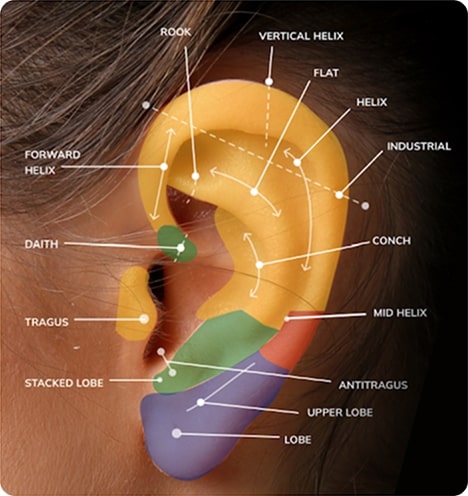
An ear piercing chart is a labeled map of the ear that shows every piercing placement by name and location—from the lobe up through the cartilage. Use the chart below to compare all types of ear piercings side by side, including each spot's location on the ear, a pain level from 1 to 10, and a typical healing time, then jump to the section you need.
On this page: Ear piercing chart · Ear piercings names · Triple ear piercing · Types of ear piercings · Pain & healing time · FAQ
Ear Piercing Chart: All 16 Types of Ear Piercings
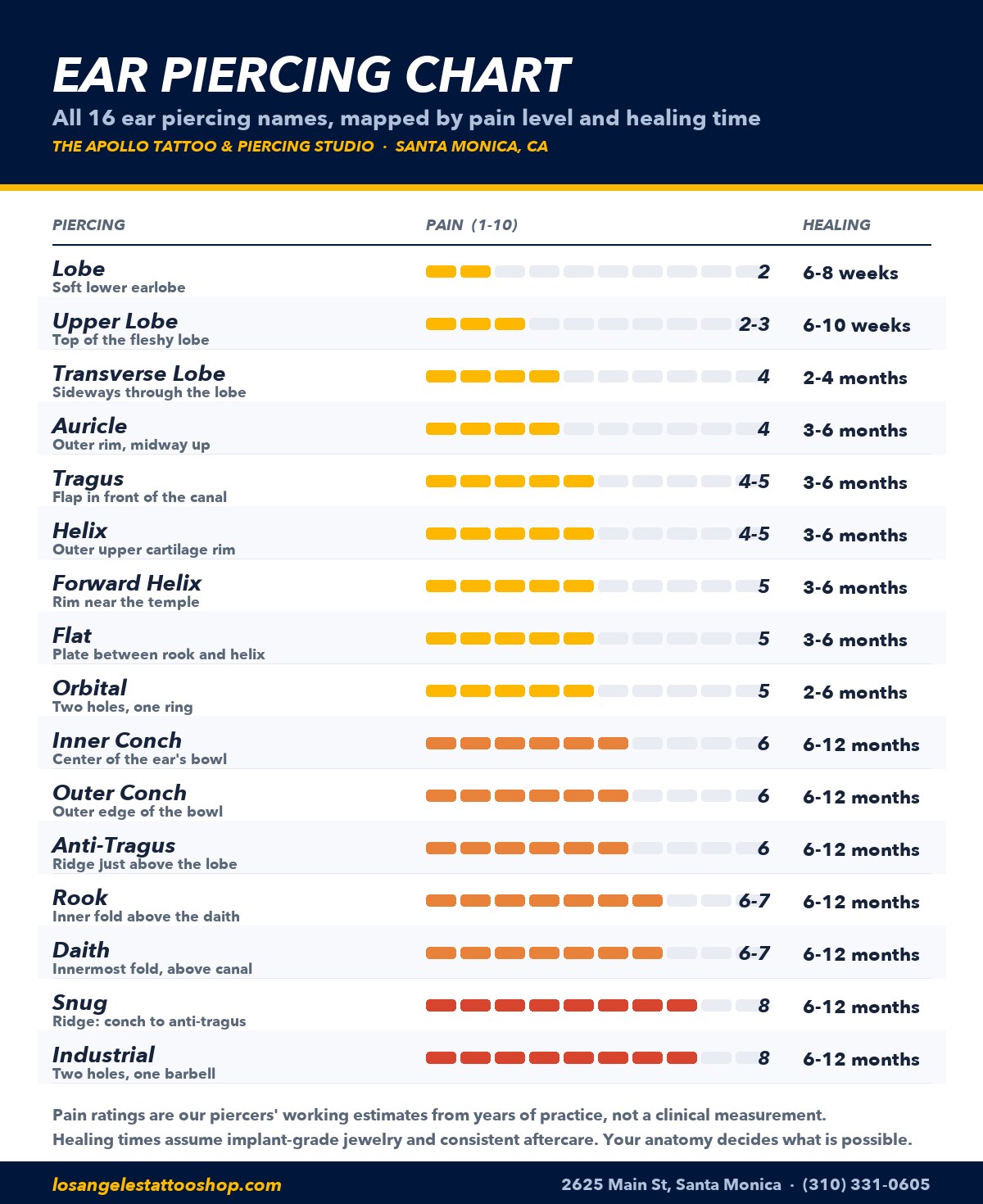
This ear piercing chart lists every ear piercing type by location, with an approximate pain level (1–10) and average healing time. The pain numbers are our piercers' working estimates from years of doing these placements, not a clinical measurement, and healing varies with your anatomy, jewelry and aftercare. Treat both columns as an honest general guide rather than a promise.
| Ear Piercing | Location on the Ear | Pain Level (1–10) | Healing Time |
|---|---|---|---|
| Lobe | Soft, fleshy lower earlobe | 2 | 6–8 weeks |
| Upper Lobe | Top of the fleshy lobe, above the standard lobe | 2–3 | 6–10 weeks |
| Transverse Lobe | Horizontally through the lobe with a barbell | 4 | 2–4 months |
| Helix | Outer upper cartilage rim | 4–5 | 3–6 months |
| Forward Helix | Upper rim near the temple, above the tragus | 5 | 3–6 months |
| Flat | Flat upper cartilage between the rook and helix | 5 | 3–6 months |
| Industrial | Two holes joined by one barbell across the upper cartilage | 8 | 6–12 months |
| Rook | Inner antihelix fold above the daith | 6–7 | 6–12 months |
| Daith | Innermost cartilage fold above the ear canal | 6–7 | 6–12 months |
| Tragus | Thick flap in front of the ear canal | 4–5 | 3–6 months |
| Anti-Tragus | Ridge just above the lobe, opposite the tragus | 6 | 6–12 months |
| Inner Conch | Center of the ear's bowl-shaped cartilage | 6 | 6–12 months |
| Outer Conch | Outer edge of the ear's bowl | 6 | 6–12 months |
| Snug | Inner cartilage ridge between the conch and anti-tragus | 8 | 6–12 months |
| Orbital | Two holes joined by one ring, usually in the lobe or conch | 5 | 2–6 months |
| Auricle | Outer rim midway between the lobe and helix | 4 | 3–6 months |
Planning a curated ear? Explore our curated ear piercing in Los Angeles service, browse all of our ear and body piercings, or book ear piercing at our LA shop. New to it all? Start at our ear piercing in Los Angeles page to see pricing, jewelry, and how to book.
Ear Piercings Names: All 16, Grouped by Ear Zone
The ear piercings names are lobe, upper lobe, transverse lobe, helix, forward helix, flat, industrial, rook, daith, tragus, anti-tragus, inner conch, outer conch, snug, orbital and auricle. Every ear piercing name comes from the piece of ear anatomy the needle passes through, which is why a rook is a rook in Santa Monica, London or Tokyo.
That is the whole of ear piercing terminology: learn the four zones of the ear and the names stop being jargon. Here is each name filed under the zone it belongs to, with in-depth guides for the ones we are asked about most.
- Lobe zone, soft tissue. Lobe, upper lobe, stacked lobe and transverse lobe. The fleshy lower ear, and the reason almost everyone's first piercing lives here.
- Outer rim, the helix. Helix, forward helix, flat, auricle and industrial. Everything along or across the curled outer edge.
- Inner folds. Rook, snug and daith. The ridges tucked inside the rim, all of them thick cartilage.
- Bowl and canal. Inner and outer conch, tragus and anti-tragus. The shell-shaped center, and the two small flaps guarding the ear canal.
- Named for the jewelry, not the spot. Industrial and orbital are the two exceptions. Both are a pair of holes joined by one barbell or ring, so the name describes the hardware rather than a single location.
What are all the ear piercings called?
All 16 are named above. You will also hear informal words for combinations rather than placements: a "constellation" or a "curated ear" is a styled set of several piercings, not a piercing in its own right, and a "stacked lobe" is simply two or more lobe piercings in a line. If someone quotes you a piercing name that is not on the list of 16, it is almost always one of these styling terms.
Ear piercing names and locations on the ear
Names map to locations, not to looks. Reading from the earlobe upward and inward: the lobe is the soft lower tissue. The auricle sits on the outer rim midway up. The helix runs along the top of that rim, and the forward helix is the same rim where it turns in toward your temple. The flat is the broad plate of cartilage inside the helix. The rook and snug are two inner ridges, rook higher and snug lower. The daith is the innermost fold directly above the ear canal. The conch is the bowl in the middle. The tragus and anti-tragus are the small flaps in front of and below the canal.
Ear piercing names and pain levels, least to most
Ordered by the pain ratings in the chart above. These are our piercers' working estimates from years of doing them, not a clinical measurement, and your own experience will move a point or two either way:
Lobe and upper lobe (2–3), transverse lobe and auricle (4), tragus and helix (4–5), forward helix, flat and orbital (5), conch and anti-tragus (6), rook and daith (6–7), then snug and industrial (8).
Pain is the short part. Healing is the long part, and the order is roughly the same. A lobe is done with in 6–8 weeks. Anything in cartilage, which is every name from helix onward on that list, is a 3-to-12-month commitment. That matters far more to your day-to-day than the few seconds of the piercing itself.
Triple Ear Piercing: What It Is and What It Costs
A triple ear piercing is three piercings done in one sitting. It is a booking rather than a placement, so the three can be any of the names above. The arrangements we are asked for most are the triple lobe (three studs stacked up the lobe), the triple helix (three along the outer rim) and the triple forward helix (three climbing the rim by the temple).
Doing three at once is mostly a question about your ear, not your nerve. Three lobe piercings heal in parallel without much trouble, because the lobe is soft tissue and closes up in 6–8 weeks. Three cartilage piercings on the same ear is a harder ask: they all heal for months at a time, you cannot sleep on that side while they do, and one irritated piercing tends to bother its neighbors. Our piercers will say so plainly if your anatomy will not take all three. A triple forward helix in particular needs enough rim to space them properly.
Apollo's Triple Ear service is $175 for the piercing, with jewelry priced separately. If you are planning more than three, the Curated Ear sitting fee is $99 for up to four ear piercings in one visit, and any two piercings together are $75. Full details are on our piercing prices page.
The History of Ear Piercings
From ancient Egypt and tribal rites to punk rebellion and minimalist luxury, ear piercings have always made statements. Some symbolized status or spirituality. Others expressed rebellion or renewal. Today, the piercing process has evolved into a personalized ritual, where different piercings reflect identity, emotion, and intention.
Ear Piercing Chart, Map & Diagram: How to Read It
At Apollo, we use a comprehensive ear piercing chart to guide each client. These visual tools typically display types of piercings from both front and side angles. You’ll find terms like tragus piercing, rook piercing, or conch piercing, labeled clearly for reference. This chart is your go-to guide for understanding how each piercing is performed, what part of the ear it targets, and how multiple piercings can flow visually.
Symbolism & Meaning of Placements Associated with Different Ear Piercings
Each ear piercing can hold symbolic or aesthetic value:
- Tragus piercing – Strength, grounded thinking
- Helix piercing – Freedom, individualism
- Daith piercing – Healing, internal clarity (sometimes associated with migraines)
- Snug piercing – Resilience, endurance
- Forward helix piercing – Direction, confidence
Whether chosen for function or form, these piercing types can mirror your journey.
Types of Ear Piercings Explained, One by One
Understanding the different types of ear piercings starts with anatomy. Your ear has multiple zones that allow for unique placements, styling combos, and expressions of identity. Below, we detail the most popular piercing types, where they are located, and what makes each one distinct.
Planning more than one? Our curated ear service maps these placements to your anatomy, and you can book any of them at our Santa Monica studio.
Lobe Piercing
The earlobe is the soft, fleshy lower portion of the ear. It’s typically the site for the first piercing due to its low pain level and fast healing.
- Classic lobe piercing: A single hole centered on the lobe—versatile and timeless.
- Stacked lobe: Vertical alignment of two or more piercings, perfect for curated looks.
- Transverse lobe piercing: A unique horizontal piercing through the lobe, using a barbell.
Helix Piercings
Helix piercings are located on the outer rim of the ear, along the upper ear cartilage.
- Standard helix piercing: A staple upper ear look; perfect for hoops and studs.
- Forward helix piercing: Positioned above the tragus near the temple; often stacked in twos or threes.
- Hidden helix piercing: Tucked subtly under the rim; a minimalist option with maximum style.
Helix piercings offer both versatility and visual impact, whether you choose a single hoop or a curated stack.
Daith Piercing
This inner ear piercing goes through the innermost fold of the ear cartilage near the ear canal.
- The daith piercing is located deep within the conch area.
- The daith piercing has gained popularity for its aesthetics and alleged therapeutic effects.
Rook Piercing
Situated in the fold of the ear above the daith, the rook piercing is bold and visually striking.
- It targets thick inner cartilage and often complements daith and helix piercings.
Tragus Piercing
The tragus piercing is placed on the small, thick flap that partially covers the ear canal.
- A compact space that can accommodate subtle jewelry while making a strong statement.
Conch Piercing
Found in the center of the ear’s bowl-like structure.
- Inner conch piercing: A stud placed in the middle of the ear.
- Outer conch piercing: Usually suited for hoops that hug the ear’s edge.
Industrial Piercing
This piercing involves two holes through the upper ear cartilage. This setup connects two piercings in the upper ear and requires precise anatomy.
A dramatic, architectural look that crosses the ear diagonally.
Best suited for ears with enough structure to support alignment.
Cartilage Piercing
An umbrella term that includes any piercing type on the ear cartilage. Cartilage piercing goes through firmer tissue, requiring longer healing but offering more styling flexibility.
- May include helix, rook, snug, and flat piercings.
- Can be placed along the top of the ear, outer rim, or flat piercing areas.
Orbital Piercing
An orbital piercing consists of two piercings connected by one ring.
- Often located in the lobe or conch region.
- Provides movement and symmetry with a single piece of jewelry.
Snug Piercing
This piercing targets the inner ridge of cartilage between the outer conch and the anti-tragus.
- The snug piercing is located deeper in the ear and is considered one of the more painful ear piercings.
Anti-Tragus Piercing
Located just above the lobe and opposite the tragus.
- Anti-tragus piercing is located on the fold of the ear cartilage.
- It offers a more adventurous alternative to standard lower-lobe placements.
Pain Levels & Healing Process
Not all piercings are created equal—some piercings are less prone to irritation than others, some are simple and quick to heal, while others demand a bit more patience and care. Here’s how common ear piercing types compare in terms of pain and recovery:
| Piercing Type | Pain Level | Healing Time |
|---|---|---|
| Lobe Piercing | 2/10 | 6–8 weeks |
| Helix Piercing | 5/10 | 3–6 months |
| Daith, Rook, Conch Piercings | 6–8/10 | 6–12 months |
| Industrial & Snug Piercings | 8/10+ | Up to 12 months |
Jewelry 101: Piercing Jewelry & Ear Adornments
Choosing the right piercing jewelry is as important as the piercing placement itself:
- We only use implant-grade titanium and 14k gold
- Jewelry must suit your ear cartilage and healing stage
- Options include studs, hoops, barbells, and curated stacks
Whether you’re seeking timeless elegance or bold expression, the right ear adornments elevate every piercing type. We curate only the highest quality ear jewelry to ensure safe healing and standout looks.
Piercing Placement & Visual Harmony
How your ear piercing is located impacts its effect. That’s why we offer custom earscraping, a visual styling plan tailored to your anatomy. By combining multiple piercings across the outer ear and inner ear, we create symmetry and storytelling with every look.
Trendy vs. Timeless Placements
Modern styles like hidden helix piercing, stacked lobes, and flat piercing are rising in popularity. Still, some clients prefer the elegance of a classic lobe piercing or forward helix piercing. At Apollo, we help you balance aesthetic vision with practicality and long-term style.
Expressing Identity Through Piercing
Every ear piercing is more than a style choice; it’s a reflection of identity. Whether it’s your first piercing or part of a more curated design, the ultimate ear piercing chart helps you map out not just placements, but personal meaning.
From honoring milestones to reclaiming autonomy, piercing is often a transformative act. At Apollo, we work closely with you to design something that mirrors your energy, story, and aesthetic. We see piercings not just as adornments, but as symbols of selfhood—crafted with purpose and care.
Santa Monica Studio Highlight
Looking for the best ear piercing experience in Los Angeles? You’ve found it. Apollo Tattoo & Piercing Studio is proud to serve clients across Santa Monica, Venice, and the broader Los Angeles piercing community. We welcome walk-ins and appointment bookings from all over LA County.
While this guide focuses on ear piercing, it’s just one part of what we offer. As one of the most-trusted piercing shops in Los Angeles, Apollo provides a full range of services—from ear piercing in Los Angeles and nose piercings and lip piercings to eyebrow, navel, tongue, dermal, and even kids’ ear piercings. Local to the Westside? Book your piercing in Santa Monica. Whether you’re building a look or marking a moment, we’re here to guide you through it with expertise and care.
The Apollo Tattoo Studio is located at 2625 Main St, near the California Heritage Museum and Ocean View Park. We provide a calm, artful space where your vision is supported, from the first piercing to advanced piercing placements.
Frequently Asked Questions
What is an ear piercing chart?
An ear piercing chart is a labeled diagram of the ear that maps every piercing placement by name and location, from the lobe to the upper cartilage. It helps you see where each piercing type sits, compare pain levels and healing times, and plan a curated ear before you book.
How many types of ear piercings are there?
There are 16 recognized types of ear piercings, including the lobe, upper lobe, transverse lobe, helix, forward helix, flat, industrial, rook, daith, tragus, anti-tragus, inner conch, outer conch, snug, orbital, and auricle. Most people combine several placements to build a curated ear.
Which ear piercing hurts the most?
The industrial and snug piercings are widely considered the most painful, both rating around 8 out of 10 because they pass through dense, thick cartilage. The rook and daith are close behind, while the lobe is the least painful at about 2 out of 10.
How long do ear piercings take to heal?
Lobe piercings heal fastest, in about 6 to 8 weeks. Cartilage piercings such as the helix, tragus, daith, rook, conch, industrial, and snug take much longer, usually 3 to 12 months of consistent aftercare.
What is the most painful ear piercing?
The industrial piercing and snug piercing top the pain scale, both reaching 8 out of 10 or higher. The industrial connects two holes with a barbell across the upper ear, while the snug targets a thick inner ridge of cartilage. Healing can take up to a year, so we guide clients carefully through aftercare.
Can I get all my piercings in one session?
It depends on your anatomy and the healing process. We often recommend staggered sessions so each placement can heal comfortably.
Do I need specific anatomy for a certain piercing?
Yes. For example, snug piercings sit best on ears with enough inner cartilage depth, which is why we assess your anatomy before recommending a placement.
How do I know if a piercing will look good on me?
We offer styling consults that map the front of the ear, its natural flow, and the ideal piercing placements for your anatomy.
What is a good starter piercing?
Lobe piercings are the most common first piercing thanks to low pain and fast healing. They are perfect for those new to piercing and offer endless styling potential.
What is a flat piercing, and where does it sit?
The flat piercing sits on the upper cartilage between the rook and helix. It is ideal for studs, clusters, and statement pieces that lie flat against the ear.
What are all the ear piercings called?
The 16 ear piercing names are lobe, upper lobe, transverse lobe, helix, forward helix, flat, industrial, rook, daith, tragus, anti-tragus, inner conch, outer conch, snug, orbital and auricle. Each name comes from the part of the ear anatomy the piercing passes through, so the names are the same in every professional studio.
What is a triple ear piercing?
A triple ear piercing is three piercings done in one sitting, most often three stacked lobes, three along the helix, or three forward helix. Apollo's Triple Ear service is $175 for the piercing, with jewelry priced separately. We check that your anatomy can space all three before we start.
What is the difference between an ear piercing chart, a map and a diagram?
Nothing. Chart, map and diagram all describe the same thing: a labeled picture of the ear showing where each piercing sits and what it is called. A useful one adds a pain rating and a healing time, because those are the two things the picture alone cannot tell you.
If you want the evidence behind the cartilage-versus-lobe question rather than the received wisdom, our piercing safety statistics page collects the peer-reviewed complication rates by site, the materials standards that actually mean something, and the California statute governing ear piercing — with every figure traced to its source.