From the Studio
Why People Get Medusa Tattoos
A short guide to the three reasons people choose a Medusa piece — protection, survival, and power — plus the styles and placements that suit each one. For the full deep-dive on Medusa tattoo meaning, myth and symbolism, read our complete guide.
Medusa is one of the most requested pieces walking into the studio right now, and almost nobody means exactly the same thing by it. Ask ten people what their Medusa tattoo means and you'll get three answers: protection, survival, and power. All three are real, all three trace back to the myth, and the one you lead with should shape the design you book. This is a plain-English guide to what a Medusa tattoo means, how the meanings show up in styles and placements, and how to choose the reading that's actually yours. For the full mythological and art-history deep-dive, see our companion piece on the meaning of Medusa tattoos in the lore library.
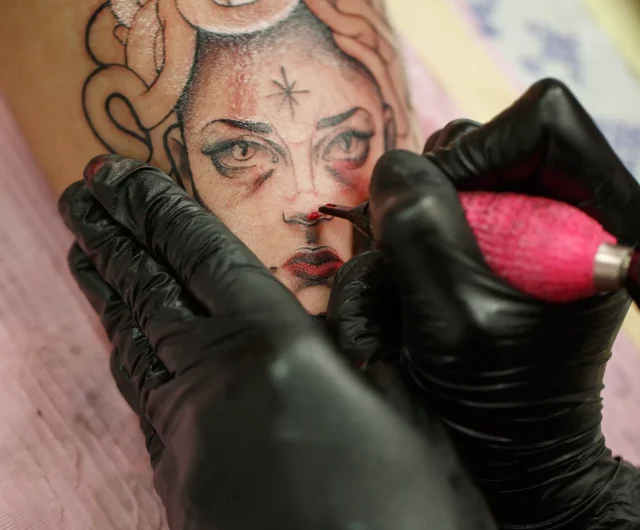
The Three Meanings of a Medusa Tattoo
Before you look at flash or scroll an artist's portfolio, it helps to know which of the three readings you're carrying. They overlap, but they pull a composition in different directions.
1. Protection — the oldest meaning
Long before Medusa was a victim or a feminist icon, her face was a ward. The Greeks called it the Gorgoneion: a carved or painted Medusa head placed on shields, armor, and temple doorways from roughly the 7th century BCE to turn away evil and stop harm at the threshold. This is the "apotropaic" meaning — a face so fearsome it protects the person who wears it. If you're drawn to Medusa as a guardian, a boundary, a keep-away, you're in the oldest tradition there is.
2. Survival and reclamation — the modern meaning
The reading most clients arrive with today comes from the Roman poet Ovid. In his Metamorphoses, Medusa isn't born a monster — she's a mortal woman, a priestess in Athena's temple, assaulted there by the sea god Poseidon. Athena punishes Medusa for it, turning her hair to snakes and her gaze to stone, and she is later hunted and beheaded for the crime of having been harmed.
Since the #MeToo movement of 2017–2018 — and especially since the 2020 installation of Luciano Garbati's sculpture Medusa With the Head of Perseus near a New York courthouse — that story has been reclaimed. Survivors of assault choose Medusa to mark their own survival, or someone they love's: righteous anger, a body that endured, a punishment that was never theirs to carry. If this is your reason, it's a real and honored one. We ask about it gently in the consultation because it changes what the eyes and the expression need to do. We also keep a broader page on reclamation and survivor tattoos for anyone thinking through a piece like this. And a note we make to every client: worn by someone it doesn't belong to, the survivor reading is something the symbol notices — if it's yours, it's yours, and if it isn't, the protection and power readings are wide open.
3. Power — beauty that won't be possessed
The third reading is the one Versace put on a logo and pop feminism put on a poster: Medusa as a gaze that refuses to be the passive object of anyone else's looking. Not a victim, not a guardian — a force. Clients who choose this reading usually want a direct, forward-facing stare and a composition that reads as a crown rather than a threat. It's confident, unbothered, and it photographs beautifully.

The Story of Medusa, Briefly
Two classical sources feed every Medusa tattoo. Hesiod's Theogony (around 700 BCE) gives the oldest version — Medusa as one of three Gorgon sisters, the only mortal one, slain by Perseus with Athena's mirror-shield and Hermes's sickle; from her severed neck spring the winged horse Pegasus and the giant Chrysaor. Ovid's Metamorphoses (around 8 CE) adds the backstory most people know: the beautiful priestess, the assault, the punishment, the snakes, the petrifying stare. Hesiod is the source; Ovid is the reworking. Knowing which version you're drawing from is the difference between a monster tattoo and a survivor tattoo — the snakes look similar, but the eyes tell two different stories.
Popular Medusa Tattoo Styles
Medusa is a portrait subject, so style matters more than with a simple icon. Here's where each style lands, and which reading it tends to serve.
- Black and gray realism — the dominant choice for serious survivor and classical pieces. Think sculpture: Caravaggio, Hellenistic references, deep contrast, multiple sessions. It wants scale and it rewards patience. Browse our black-and-gray realism work to see the range.
- Neo-traditional — bold outlines, an expanded color palette, stylized snakes. Great for a decorative, mid-scale Medusa that still reads across a room.
- American traditional — the Gorgoneion flash style: smaller, iconic, high-contrast, honest about being a symbol rather than a portrait. See our traditional tattoo gallery.
- Fine line — delicate and botanical, the face rendered as a drawing rather than a carving. Beautiful, with one caveat: the eyes still have to carry the piece, so pick your artist on healed work.
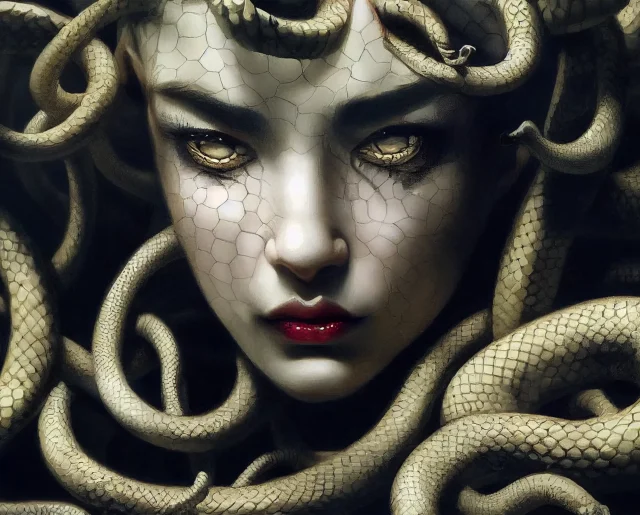
One thing that unites every good Medusa, regardless of style: the eyes and the snakes. The gaze is the entire point of the myth, so weak eyes sink the tattoo no matter how clean the linework is. And the snakes carry their own logic — converging on the face reads as threat, radiating outward reads as a crown. If serpents are a big part of your idea, our piece on snake tattoo mythology and meanings goes deeper on what they signal.
Popular Placements and What They Suggest
Because Medusa wants room, placement is a real decision — pick it with your artist based on the size and style, not the reverse. These are the spots we see most, and the feel each one tends to carry.
Forearm: the most-requested placement — visible, conversational, and well suited to a bold, iconic rendering.
Upper arm and shoulder: room for detail with the option to keep it private; a natural home for the protection reading.
Thigh: the sweet spot for large black-and-gray realism — a big, flat canvas that holds fine detail and heals well.
Back: for a statement piece or a full narrative composition; the place to go big.
Chest and sternum: read as close to the heart — favored for the survivor and empowerment readings, and for symmetry-forward designs.
Are Medusa Tattoos Only for Women?
No. Medusa is traditionally read as a feminine figure, and the survivor and empowerment meanings resonate strongly with women — but the protection and power readings are universal, and Medusa is chosen by people of every gender. The design flexes to the wearer: a stark, menacing Gorgoneion and a soft, sorrowful portrait are the same myth pointed in different directions.
Can a Medusa Tattoo Cover Scars?
Yes — it's one of the stronger cover-up subjects in the survivor catalog. The radiating snakes give an artist flexibility to route around or across scar tissue, and the composition absorbs asymmetry that a simpler subject would expose. If you're considering a Medusa over scars tied to a precipitating event, name it directly in the consultation, and ask specifically to see healed scar-coverage work — not every artist who tattoos Medusa also does scar work well.

How to Choose Your Medusa Tattoo
Put the pieces together before you book:
- Pick your reading — protection, survival, or power. It decides the expression and the eyes.
- Match a style to it — realism for depth and gravity, neo-traditional or traditional for a bolder icon, fine line for something quiet.
- Scale it honestly — Medusa is a portrait. Give it room; a face crammed too small loses the eyes and the snakes both.
- Choose the artist on healed work — especially the eyes and the scar-coverage portfolio if that applies to you.
- Bring your reference and your reason — a good consultation asks which Medusa you mean, and builds the composition around your answer.
Want the full mythological background, the art-history lineage, and the composition choices in depth? Read Medusa Tattoo Meaning: Symbolism, Myth & Modern Meaning in our lore library.
Book Your Medusa Tattoo in Santa Monica
Apollo Tattoo & Piercing Studio has been designing meaningful, portrait-grade tattoos on Main Street in Santa Monica for years. Bring us your reading and your reference and we'll build the piece around it. Book a consultation or call the studio to get started.
Yes! I'm ready for new inkCALL NOW